How to Eat in Rome Without the Confusion
Restaurant etiquette, ordering food, tipping, and the cultural differences that surprise North American visitors.
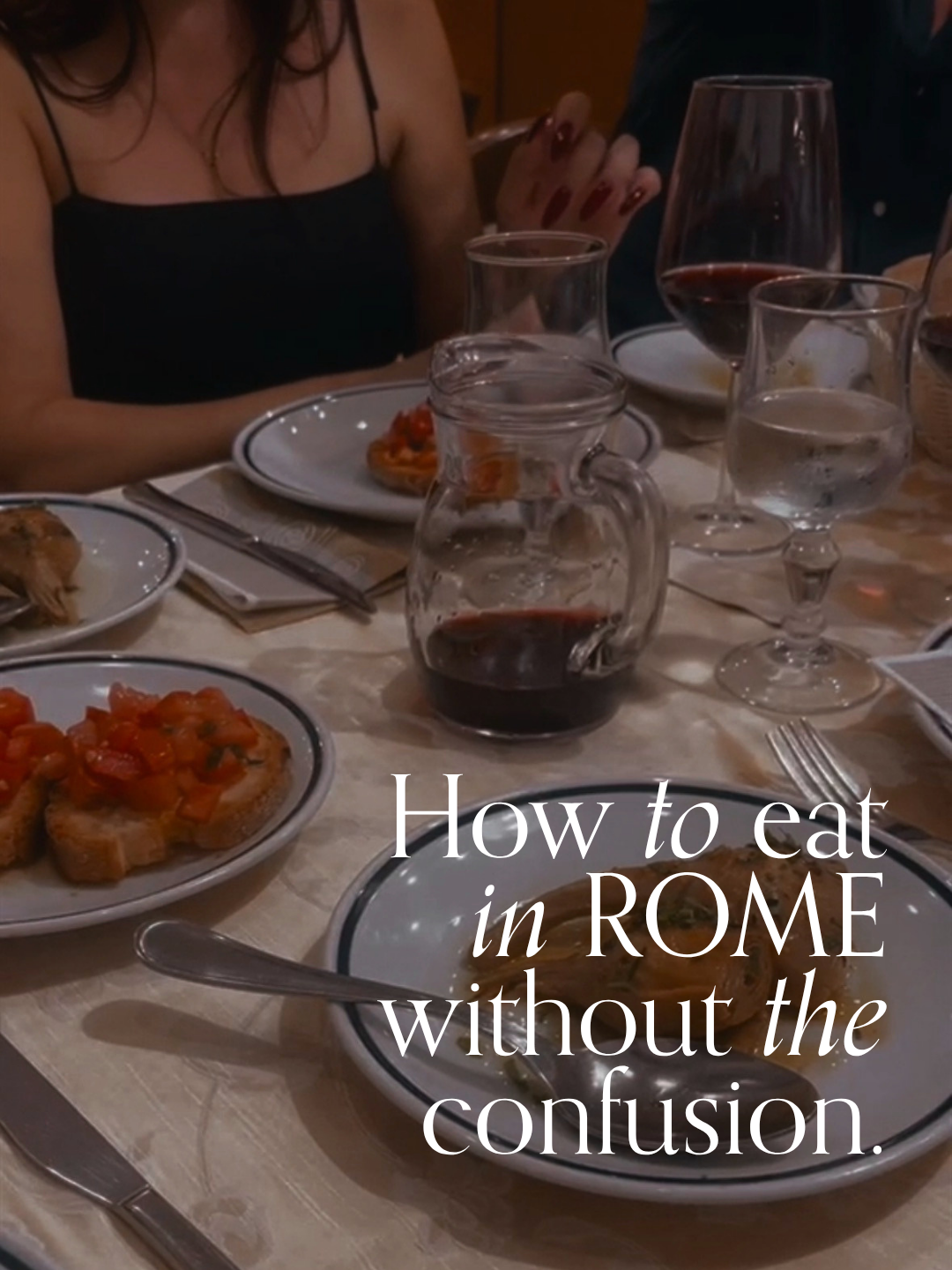
In Rome, you will find that the restaurant experience lands a little differently.
Dinner here isn't a transaction to be completed efficiently. It's the evening itself.
That may be why your waiter seems less attentive than you expected, why the bill never comes the second you put down your fork, and why you might sit for twenty minutes wondering whether someone has forgotten about you.
If you're visiting from North America, some of the things you've been taught to expect from a restaurant simply don't apply here.
I speak from firsthand embarrassing experiences. These are cultural differences I learned the hard way.
Once you understand them, eating out in Rome becomes considerably easier.
1. Your waiter is probably not ignoring you
In North America, attentive service often means frequent check-ins. Someone takes your order, brings your food, asks how everything tastes, refills your water, clears your plates, and offers the bill when you appear finished.
We are used to that rhythm.
In Rome, the approach is different.
A waiter might take your order, deliver your food, and then leave you alone for much of the evening.
You can easily misread this as poor service, especially when you're accustomed to someone checking on your table every few minutes.
But in many Roman restaurants, the expectation is that you're there to enjoy your meal and your company. The waiter isn't supposed to be the main character at your table.
If you need something, get their attention politely and ask.
Don't sit there getting increasingly irritated because nobody has come over to ask whether you're enjoying your pasta.
You are allowed to ask for what you need.
And when you're ready to leave, you ask for the bill.
Il conto, per favore.
That's it.
2. Your reserved dinner table is generally yours for the evening
This is one of the differences I appreciate most.
In North America, many popular restaurants work around timed reservations. You might have ninety minutes before the restaurant needs your table for the next booking.
You finish eating, the plates disappear, and the bill arrives. The message is understood.
In Rome, unless a restaurant operates multiple seatings or has told you about a time limit, your reservation will often be treated as your table for the evening.
You don't have to finish dessert and immediately leave.
You can order another glass of wine. You can talk. You can sit for a while after you've finished eating.
Not every restaurant operates this way, particularly busy places in the historic center, so pay attention to any seating conditions when you book.
But don't assume that being left alone means you've been forgotten.
And don't assume you need to leave the moment your plates are cleared.
3. Osteria, trattoria, ristorante, enoteca. What is the difference?
In North America, we use the word restaurant for practically everywhere we go out to eat.
In Italy, the word on the sign traditionally tells you something about the type of meal you'll have.
These distinctions aren't as rigid as they once were. An expensive modern osteria can cost more than a neighborhood ristorante, so don't treat the name as a guaranteed price category.
But understanding the traditional differences is useful.
Osteria
Historically, an osteria was a simple place to drink wine, often with a limited selection of food.
Today, many osterie serve full meals. You can generally expect a relatively informal atmosphere, a smaller menu, and dishes connected to local cooking.
Some are inexpensive and rustic. Others have become rather fashionable and expensive.
Read the menu before deciding.
Trattoria
Traditionally, a trattoria is a casual, often family-run restaurant serving home-style cooking.
In Rome, this might mean a menu built around the classic Roman pastas, seasonal vegetables, meat dishes, and traditional desserts.
Don't expect elaborate presentation or particularly impressive decor.
A simple dining room with bright overhead lighting can still serve an excellent meal.
Ristorante
A ristorante traditionally suggests a more formal dining experience, with full table service, a broader menu, and sometimes a more extensive wine list.
It may also mean a higher bill.
If you ask your hotel concierge for a restaurant recommendation, be specific about what you're looking for. Otherwise, you may find yourself somewhere much more formal or expensive than you intended.
Enoteca
An enoteca is traditionally a wine shop or wine-focused establishment.
Some primarily sell bottles. Others function as wine bars where you can sit down for a glass and order food, often cheese, cured meats, or smaller dishes.
Some now serve substantial meals, too.
If you're looking for an informal evening built around wine rather than a traditional multi-course dinner, an enoteca can be a good choice.
The name is a clue, not a promise. Always look at the actual menu, prices, and type of service.
4. The menu is not a starting point for negotiation
In North America, we're comfortable modifying restaurant dishes.
No onions. Dressing on the side. Substitute the potatoes. Add chicken. Remove the cheese.
We treat the menu as a starting point and assume the kitchen will make the changes.
That expectation doesn't always translate well in Rome.
A traditional Roman dish is generally prepared in a particular way, with ingredients that are there for a reason.
Take cacio e pepe. It is a pasta dish built around Pecorino Romano and black pepper. Asking for it without cheese rather defeats the point.
Or carbonara, which traditionally contains egg, Pecorino Romano, guanciale, and black pepper.
If you don't like one of the main ingredients, it is usually easier to order something else.
This doesn't mean kitchens never accommodate preferences or dietary needs. Many do.
But there's a difference between asking a kitchen to accommodate a genuine restriction and expecting a classic dish to be completely reconstructed.
Choose something on the menu that already appeals to you.
You'll probably have a better meal.
5. If you have food allergies, tell the waiter before ordering
This is important, and it isn't simply a matter of cultural preference.
In North America, servers in many restaurants will ask whether anyone at the table has food allergies.
In Rome, your waiter might not ask.
You are expected to communicate your allergies before ordering.
Italy follows European Union food information rules requiring restaurants to provide information about specified allergens in the food they serve.
But don't confuse the existence of allergen information with a guarantee that every kitchen can safely accommodate every allergy.
If you have a serious allergy, make it clear before you order. Ask about ingredients, preparation, and the possibility of cross-contact.
A useful phrase is:
Ho una grave allergia a...
I have a severe allergy to...
You can also ask:
C'è il rischio di contaminazione crociata?
Is there a risk of cross-contact?
If you have a severe allergy, I would contact the restaurant before making a reservation and carry the details of your allergy translated into Italian.
Never assume an ingredient is absent because it isn't mentioned in the dish's name.
If the staff cannot clearly confirm that a meal can be prepared safely, choose another option.
6. You do not need to order every course
Italian menus are organized differently from many North American menus.
You will commonly see:
Antipasti: Starters, such as cured meats, cheese, vegetables, or other small dishes.
Primi: First courses, usually pasta, rice, or soup.
Secondi: Main courses, often meat or fish.
Contorni: Side dishes, generally vegetables or potatoes, usually ordered separately.
Dolci: Desserts.
When you see all these sections on a menu, it can look as though you're expected to order something from each one.
You're not.
You do not need an antipasto, a pasta dish, a secondo, a contorno, and dessert.
You also do not need to order both pasta and meat.
In Rome, I've ordered pasta with no wine. On other occasions, I've ordered a steak and mozzarella, or three different side dishes without a main course.
Most ordinary restaurants are happy to let you choose what you want from the menu.
If you only want a plate of carbonara, order the carbonara.
If you'd rather have a secondo and a vegetable side, do that.
One thing worth knowing is that a secondo doesn't necessarily arrive with the vegetables and potatoes you might expect on a North American dinner plate.
Those are often listed separately under contorni.
So if you order meat and want vegetables with it, look at that section of the menu.
And in the summer, particularly during Rome's hottest months, a lighter lunch is often a much better idea than an enormous pasta meal followed by several hours of sightseeing.
7. Why are you paying for water?
In North America, a glass of tap water often appears almost immediately after you're seated.
It's free, it gets refilled, and you don't usually think about it again.
In Rome, your waiter will often ask about water before you've even looked at the food menu.
Naturale o frizzante?
Still or sparkling?
They are generally asking which type of bottled water you would like.
And yes, you'll pay for it.
This surprises North Americans because we're accustomed to drinking water being included as part of the restaurant service.
You can ask for tap water, acqua del rubinetto, but don't assume every restaurant will offer it as its standard table-water option.
Outside restaurants, Rome has an extensive network of public drinking fountains called nasoni. You can fill your reusable bottle with drinking water at these fountains.
But inside a restaurant, paid bottled water is an ordinary part of the experience.
It isn't automatically a sign that you're being taken advantage of.
8. Tipping is not expected the way it is in North America
This might be the hardest cultural habit for North American visitors to leave behind.
We're used to a payment screen turning toward us and asking whether we'd like to add 18%, 20%, or 25%.
Even when the service was mediocre, leaving nothing feels uncomfortable.
Rome doesn't work that way.
Tipping is not a routine percentage-based obligation here.
Most card machines don't even provide a tip prompt.
Of course, if you want to leave a little extra for particularly good service, you can. Nobody is going to refuse a few euros in cash.
But you do not need to add 20% to your restaurant bill.
I don't tip.
That's not because I'm unhappy with the service. It's because I'm following the tipping customs where I live.
If you've received good service, say thank you.
Grazie, siamo stati benissimo.
Thank you, we had a wonderful time.
And pay the bill.
9. Coperto, servizio, and other restaurant charges
This is where reading your bill matters.
Many Roman restaurants charge coperto. It's a per-person cover charge, usually a few euros, and it should be listed on the menu.
It isn't a tip, and it isn't a scam. It's simply part of the bill in many places.
Some restaurants add a service charge instead of, or as well as, a cover charge. That should also be shown on the menu before you order.
If you see:
Coperto: A per-person cover charge. Common in Rome and usually listed on the menu.
Servizio: A service charge. Check that the charge was disclosed on the menu or price list before you ordered.
Pane: Bread. If bread is charged separately, check how it was presented and priced.
If something appears on the bill that you don't understand, ask.
Mi può spiegare questa voce sul conto?
Can you explain this item on the bill?
There is no need to become confrontational. Just know what you're paying for.
And remember that a cover or service charge is not the same thing as an American-style tipping expectation.
10. Children eat with their families
In North America, parents often search specifically for child-friendly restaurants.
We want a children's menu, crayons, high chairs, and something familiar to feed a picky eater.
In Rome, children are part of ordinary restaurant life.
Families bring their children to the same restaurants where adults go to eat.
You might find yourself seated beside a family with young children at dinner. That isn't unusual.
You don't need to search exclusively for places advertising themselves as family restaurants.
Of course, if you need a high chair, space for a stroller, or a restaurant that can accommodate a particular dietary need, it's worth checking before you book.
And not every restaurant is equally convenient with small children.
But eating out with your family doesn't have to mean limiting yourself to a children's menu.
11. Italian food is regional, and you're in Rome
One of the biggest misunderstandings about Italian food is treating it as one national restaurant menu.
In North America, we often expect an Italian restaurant to serve a little bit of everything.
Pesto. Bolognese. Carbonara. Pizza. Risotto. Maybe something with truffles.
But these dishes come from different culinary traditions.
Italian cuisine is deeply regional.
If you're in Rome, it makes sense to begin with Roman food.
The four classic Roman pasta dishes are:
Cacio e pepe: Pasta with Pecorino Romano and black pepper.
Gricia: Pasta with guanciale, Pecorino Romano, and black pepper.
Amatriciana: Pasta with guanciale, tomato, and Pecorino.
Carbonara: Pasta with guanciale, egg, Pecorino Romano, and black pepper.
You'll also see seasonal vegetables, artichokes prepared in different Roman traditions, and meat dishes that have been part of the city's cooking for generations.
That doesn't mean you can't eat Tuscan, Neapolitan, Sicilian, or international food in Rome. You absolutely can.
But if you're visiting Rome and want to understand the city's food, start with what is traditionally cooked here.
You don't have to eat carbonara every night.
And you certainly don't need to spend your entire trip chasing the pasta restaurant that went viral on Instagram.
12. Stop chasing the best restaurant in Rome
I've said this before, and I think it's worth repeating.
There is no single best pasta restaurant in Rome.
I've had disappointing food in places with wonderful views and excellent food in restaurants that look like they haven't updated their decor in thirty years.
I've paid too much to eat in front of the Pantheon. I loved the view and liked the food considerably less.
There's nothing wrong with choosing a restaurant for its location. Sometimes that's exactly what you want.
Just understand that you're paying for the location as well as the meal.
My advice is to stop letting lists of supposedly essential restaurants dictate every dinner.
Look at the menu. Read recent Google reviews, including reviews written by Italians. Walk past and see whether somewhere appeals to you.
A dated dining room with dull lighting isn't necessarily a bad restaurant.
And a long line outside a restaurant doesn't automatically mean its food is better than the place next door.
Sometimes it simply means the restaurant went viral.
When I travel, I can fall into the same trap of trying to find the best of everything.
But turning every meal into a reservation you absolutely must secure takes some of the pleasure out of eating.
You don't need to win Rome by finding its best carbonara. You need to have a good dinner.
A few Italian phrases that make eating out easier
You don't need to speak fluent Italian to eat in Rome. But a few phrases are useful.
Buonasera, abbiamo una prenotazione.
Good evening, we have a reservation.
Un tavolo per due, per favore.
A table for two, please.
Acqua naturale, per favore.
Still water, please.
Acqua frizzante, per favore.
Sparkling water, please.
Vorrei ordinare...
I would like to order...
Il conto, per favore.
The bill, please.
Grazie, era tutto buonissimo.
Thank you, everything was delicious.
And while we're here, it's broo-SKET-tah, not broo-SHET-ah.
One last thing about eating in Rome
The restaurant experience here is not designed around the same expectations you might have at home.
You may have to ask for the waiter.
You will probably pay for your bottled water.
Your pasta might arrive without the substitutions you're accustomed to requesting.
Nobody expects you to tip 20%.
And your waiter isn't necessarily going to bring your bill until you ask.
None of this has to be confusing once you understand the system.
Try not to default to North American instincts in a city that doesn't share them.
Dinner doesn't need to be something you finish efficiently before moving on to the next activity.
It can be the evening itself.
Want more practical help before your first restaurant meal in Rome?
I've put together a free guide, How to Eat in Rome Without Confusion, explaining the restaurant terminology, ordering customs, and other details worth knowing before you arrive.
Get the free How to Eat in Rome guide →